
There’s many ways to write a joke. At the Hard Knock Knocks stand-up comedy school, we teach three.
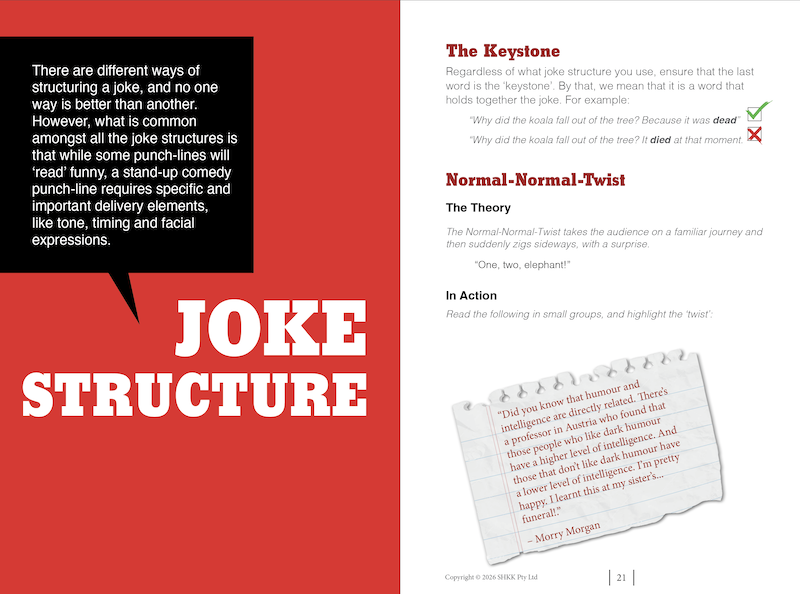
Our favourite joke structure is the Normal-Normal-Twist. The Normal-Normal-Twist takes the audience on a familiar journey and then suddenly zigs sideways, with a surprise.
The first ‘normal’ establishes a familiar idea. The second ‘normal’ strengthens the audience’s expectation. The twist then breaks that pattern with an unexpected conclusion. In other words, the audience thinks you are going to zig, but you zag. Just as importantly is the last word in the joke. We call that the ‘keystone’.
The keystone is the word or short phrase where the joke truly lands. Placing the keystone last gives the audience all the information they need before revealing the funniest detail. Here’s a first draft of a normal-normal-twist joke:
“I’m a child of divorce. I was only six, when my wife left.”
The surprising idea is my “wife,” but extra word, “left” weaken’s the impact. A tighter version would be:
“I’m a child of divorce. I was only six when I was left by my… wife.”
Now “wife” becomes the keystone and closes the joke cleanly. Adding a slight pause as well, ensure the audience hears the keystone clearly. This second version is a better example of a strong normal-normal-normal twist with a strong keystone.
After writing a joke, remove unnecessary setup, sharpen the twist, and check the final word. Read it aloud and pause after the keystone instead of talking over the laugh. Then test it in front of an audience, because rhythm and clarity often become obvious only on stage.
Great joke writing is rewriting. Start with a normal idea, guide the audience toward an expectation, twist it, and finish on the keystone. That combination turns an observation into a punchline and gives the audience the satisfying surprise they came for every single time you step onto the stage.